Will Robots Replace Nurses? Look at the Bedside
November 13, 2026
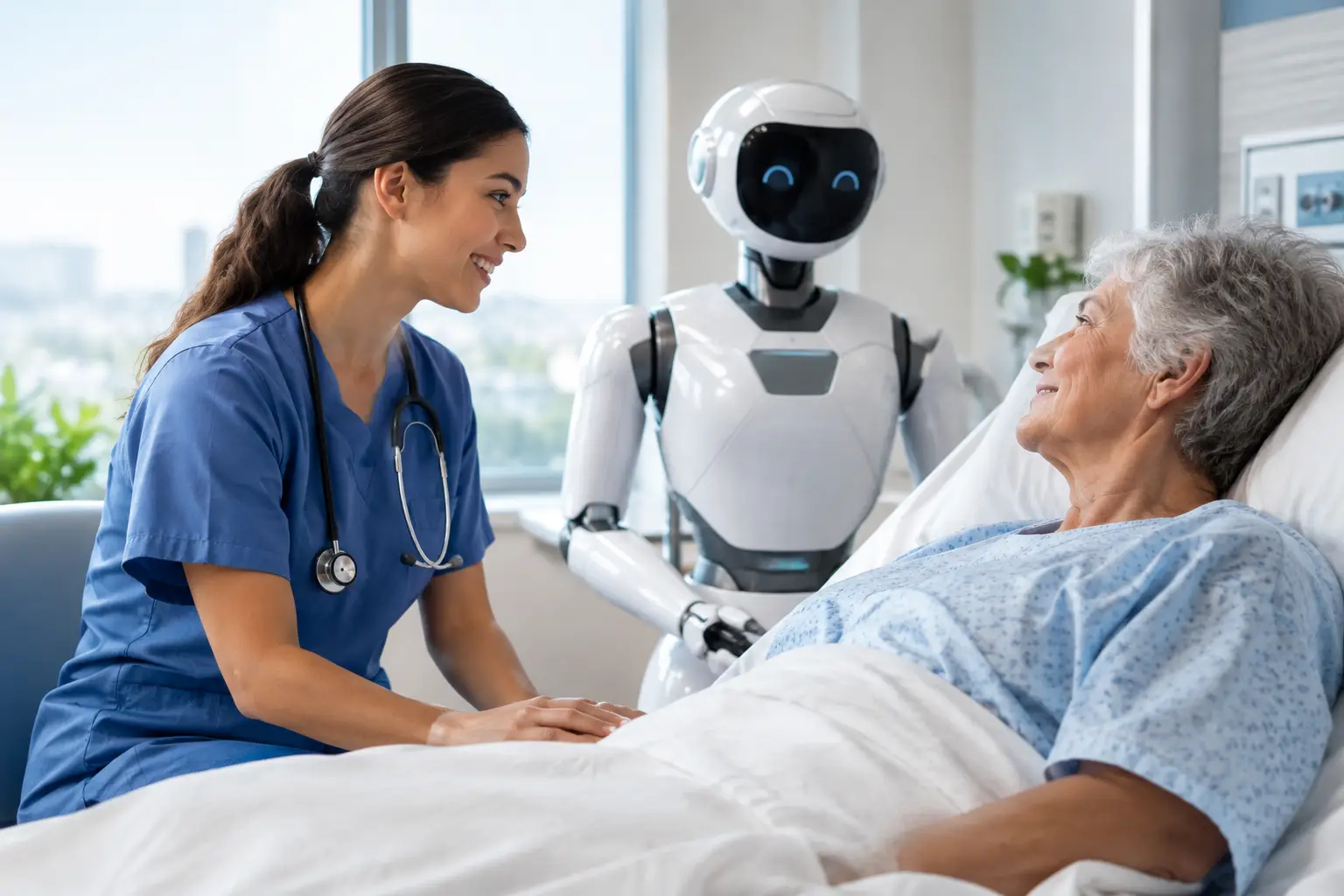
A nurse walks into a room at 3:00 a.m. and notices that a patient is breathing differently. No alarm has gone off. The monitor is still behaving like a monitor, which is to say: confidently and not always wisely. Will robots replace nurses? If that question imagines a chrome humanoid calmly taking over the night shift, the short answer is no. If it asks whether technology will rearrange nursing work, staffing budgets, and the definition of care, the answer is already yes.
The danger is not that a robot will develop a bedside manner and ask for a union contract. The danger is that hospital managers, under pressure from aging populations, staff shortages, and rising costs, will mistake measurable tasks for the whole job.
What robots can do better than exhausted people
Let us be fair to the machines. A robot does not call in sick after a double shift, does not get distracted by three simultaneous requests, and does not forget whether it delivered the linen cart to Room 12 or Room 21. Automation can transport medicines and meals, disinfect rooms, monitor inventory, remind patients about appointments, and help document routine observations.
Artificial intelligence can also spot patterns in scans, flag unusual vital signs, predict which patients may be at greater risk of falling, and sort the administrative avalanche that has turned many nurses into reluctant typists. Those are not small gains. A nurse who spends less time hunting supplies or clicking boxes may have more time for the patient sitting in front of them.
That last sentence contains the catch. Technology does not automatically give time back to care. An institution can use the saved minutes to improve staffing and attention. Or it can use them to schedule fewer people per shift and congratulate itself on innovation. Both choices can be presented in a shiny PowerPoint deck. Only one is progress.
Will robots replace nurses in the tasks that matter?
Some nursing tasks are technical. Taking a blood pressure reading is technical. Delivering a medication at the correct time is technical. Lifting, transporting, cleaning, recording, checking, and alerting can often be supported by machines, sometimes very effectively.
But nursing is not merely a sequence of tasks, any more than parenting is merely the production of packed lunches. A good nurse interprets what is not being said. They notice when a normally chatty patient has become withdrawn, when a family member is nodding politely but has understood nothing, or when someone says they are fine in the unmistakable tone that means they are very much not fine.
A robot can recognize a facial expression. It may even calculate that the expression resembles fear with 82 percent confidence. It cannot reliably understand whether fear comes from pain, a bad memory, embarrassment, a language barrier, a looming bill, or the fact that the patient has just heard a doctor use the phrase “we need to talk.” Context is not an accessory to care. It is often the care.
There is also responsibility. When a patient refuses treatment, becomes confused, or deteriorates in a way no protocol anticipated, someone must exercise judgment. That judgment carries moral weight. It is not simply a software update with a reassuring logo.
The real change: nurses with more technology around them
The future is more likely to be a mixed ward than a robot ward. Nurses will work alongside monitoring systems, smart beds, medication-dispensing devices, documentation assistants, translation tools, and perhaps robotic helpers that handle physically demanding chores. In elder care, a machine may remind someone to drink water, guide a basic exercise routine, or alert staff after a fall.
That can be helpful, especially where there are too few hands and too many patients. Europe, Japan, and the United States are all confronting versions of the same arithmetic: more older people need care while fewer working-age people are available to provide it. Pretending that human labor alone will close that gap is not compassionate. It is arithmetic denial wearing a friendly sweater.
Yet the mixed ward creates a new problem. Every new system asks nurses to learn a screen, correct a screen, feed a screen, and explain to worried patients why the screen has suddenly decided their pulse is interesting. Poorly designed technology can add work instead of removing it. Anyone who has watched a professional spend ten minutes finding the right checkbox knows that digital transformation sometimes means moving the clipboard into a more expensive building.
The best tools will be nearly boring. They will remove friction, share useful information at the right moment, and leave the nurse in charge. The worst tools will demand constant attention, generate false alarms, and turn clinical staff into unpaid quality-control departments for software vendors.
Efficiency is not the same as care
There is a seductive argument that robots are neutral. They are not. A robot reflects the priorities of the organization that buys it, the data used to train it, and the rules imposed on the people working around it.
If a hospital deploys technology primarily to cut costs, patients may receive faster but thinner care. A system can perfectly optimize a route for meal delivery while nobody notices that Mrs. Johnson has stopped eating because she is lonely. Loneliness is inefficient in a spreadsheet because it refuses to fit into a cell.
If technology is introduced to protect staff from repetitive strain, reduce paperwork, and catch risks early, the outcome can be very different. Nurses may stay in the profession longer. Burnout may ease. Patients may get more attention rather than less. The machine has not replaced the nurse in that scenario. It has replaced some of the nonsense surrounding nursing.
This distinction should shape public debate. We often ask whether a technology is possible when the more useful question is: who gains control, who carries the risk, and what happens when the system is wrong? A medication robot that makes an error is not an unfortunate weather event. Somebody selected it, configured it, supervised it, and decided how much human checking was affordable.
Patients will still want a person
There are moments when most of us become less impressed by gadgets. We may enjoy ordering groceries through an app, right until we are frightened, in pain, or waiting for news about someone we love. Then we want a person who can answer a question plainly, tolerate silence, and stay in the room for an extra minute.
That does not mean every human interaction is automatically good. Harried staff can be brusque, and machines can sometimes offer useful privacy or consistency. Some patients may prefer a digital translator for an embarrassing question. Others may welcome a robotic lifting aid because it feels safer and preserves dignity.
But choice matters. Care should not become a system in which the wealthy receive humans and everyone else gets a tablet on wheels with a cheerful voice. That is not a futuristic health system. It is a two-tier system with better batteries.
A better question than replacement
The question is not whether robots will replace nurses. The question is whether we will use automation to make nursing more human or to make care cheaper at any cost.
Nurses should be involved before systems are purchased, not invited afterward to a training session with stale sandwiches. They know where work gets stuck, which alarms are ignored, which tasks consume time, and which moments cannot be delegated. Their practical knowledge is not resistance to innovation. It is the difference between useful innovation and an expensive machine gathering dust near the supply closet.
Patients and families should ask practical questions too. Does this technology give staff more time with people? Who checks its decisions? What happens when it fails? Is there always a human being who can override it? Those questions are less glamorous than a robot demonstration, but they are considerably more valuable.
The nurse of the future may carry less paperwork, receive smarter warnings, and work beside machines that lift, deliver, translate, and calculate. Good. Let the robots do the lifting where they can. But when the room gets quiet, the news is bad, and a patient needs someone to see more than a set of numbers, we should make sure there is still a human beside the bed.